
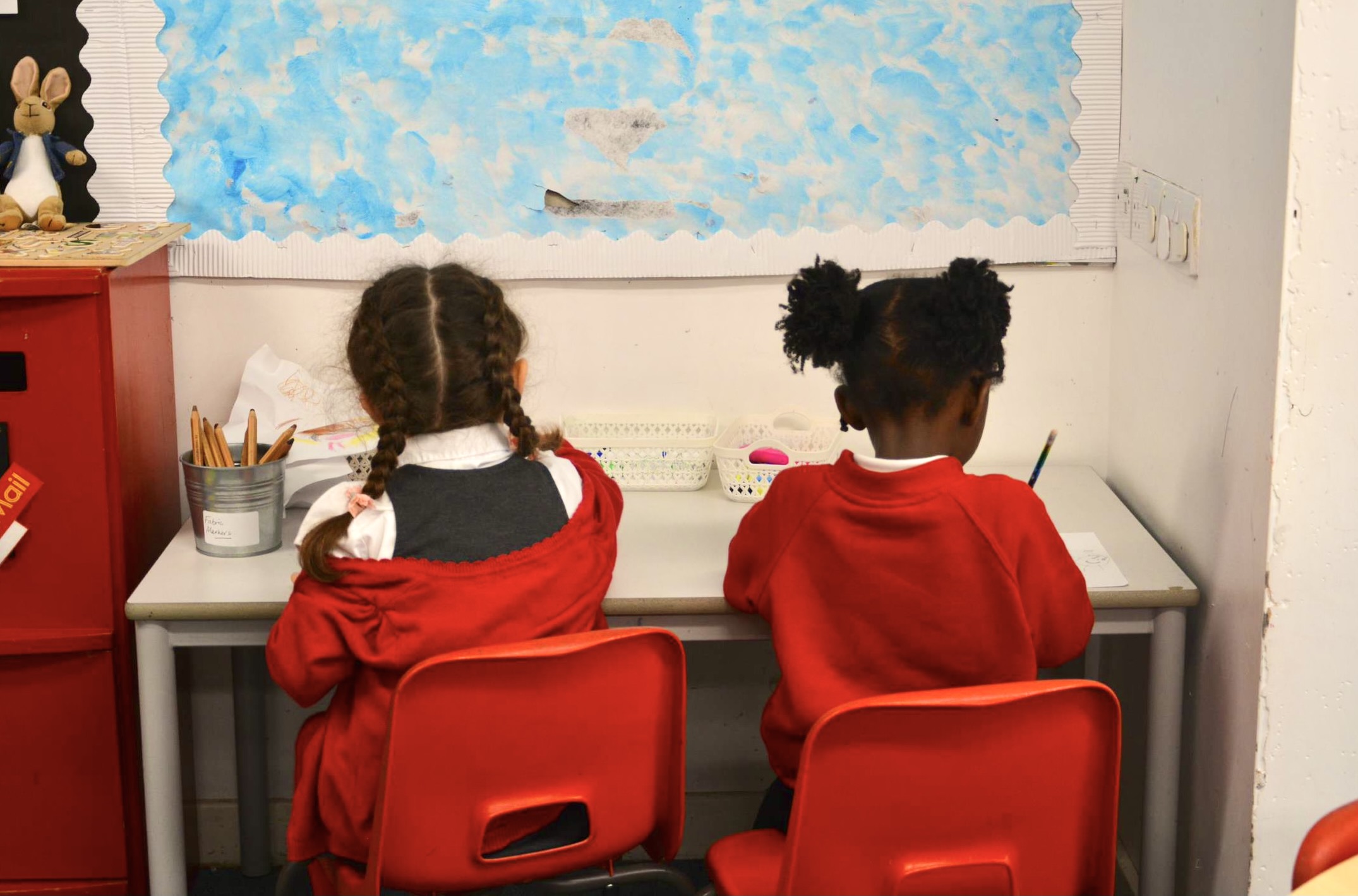
Our vision at Holy Trinity is for all children to ‘soar on the wings of eagles’, regardless of any barriers they might face. We are an inclusive school where we expect and help all children to learn and play together whatever their abilities, differences or individual needs.
Raising Aspirations
We raise aspirations for our pupils with SEND by pursuing academic excellence in all areas, according to individual need. We offer the breadth of curriculum for children with SEND, both within school and through extra-curricular activities. We enrich our curriculum with opportunities locally and across London.
Children are taught explicitly about the successes and achievements of people with SEND through our PSHE curriculum. We have also chosen our English texts carefully so that there are books to inspire children about diversity and inclusion.
Reaching Our Potential
For pupils to reach their potential, we offer a safe, welcoming and inclusive environment, where everyone has the opportunity to contribute and flourish. We aim to encourage a personal love for learning alongside high quality teaching and support. We are committed to making sure all our pupils have the chance to thrive, and support them to reach their full potential.
We ensure that all staff have the knowledge and skills to support all children with SEND in our school and dedicate INSETs to SEND training. We believe that progress in wider skills, such as speaking and listening, maintaining friendships, developing independence and keeping safe and healthy is just as important as progress in academic learning.
We know that parents are the first educators of their child and help children meet individual progress through strong partnership. We do this by: listening to their concerns, discussing their child’s strengths and individual needs; planning provision and review progress. We also work in partnership with external professionals, linking them with families and acting on their advice.
Learning to Live Well Together
Pupils learn to live well together through our school’s Christian values of: significance, peace, compassion, respect, forgiveness and courage. These engender a sense of community and belonging for all. The children enjoy whole school Worship in which we work together towards these values and encourage children to ask questions. By celebrating diversity in this way, our children learn to be respectful and compassionate towards children with SEND.
Holy Trinity’s SEND Information Report sets out what we provide for children with special educational needs and disabilities (SEND) throughout their time with us. It is designed to answer some of the key questions that parents may have when considering, or entering the school, as concisely as possible.
Please refer to our SEND Policy July 2026 for greater detail on the provision that we offer and our day-to-day procedures.
What kinds of SEND are provided for at Holy Trinity?”
The SEND Code of Practice, revised in 2014, provides guidance of the duties that schools, local authorities and others working with children who have SEND must have regard for. Our school provides additional and/or different provision for children with the following needs:
- Communication and Interaction e.g. speech, language and communication needs (SLCN); Autism Spectrum Disorder (ASD)
- Cognition and Learning e.g. Specific Learning Difficulties (SpLD), moderate learning difficulties (MLD), Severe Learning Difficulties (SLD)
- Social, Emotional and Mental Health e.g. attention deficit hyperactive disorder (ADHD); depression, eating disorder, attachment disorder, self-injury
- Physical and Sensory e.g. Visual impairment (VI); Deafness or Hearing impairment (HI); Multi-Sensory impairment (MSI); Cerebral Palsy etc.
Whilst each child’s needs are unique, the above categories help the school to broadly plan provision. Some children may have needs in more than one category.
What kinds of SEND are provided for at Holy Trinity?
The SEND Code of Practice, revised in 2014, provides guidance of the duties that schools, local authorities and others working with children who have SEND must have regard for. Our school currently provides additional and/or different provision for children with the following needs:
- Communication and Interaction e.g. speech, language and communication needs (SLCN); Autism Spectrum Disorder (ASD)
- Cognition and Learning e.g. Specific Learning Difficulties (SpLD), moderate learning difficulties (MLD), Severe Learning Difficulties (SLD)
- Social, Emotional and Mental Health e.g. attention deficit hyperactive disorder (ADHD); depression, eating disorder, attachment disorder, self-injury
- Physical and Sensory e.g. Visual impairment (VI); Deafness or Hearing impairment (HI); Multi-Sensory impairment (MSI); Cerebral Palsy etc.
Whilst each child’s needs are unique, the above categories help the school to broadly plan provision. Some children may have needs in more than one category.
Limitations of the school site
At Holy Trinity we take our duties under the Equality Act 2010 seriously and we continue to implement improvements to the school building in order to make it accessible to more children. However, the nature of the school site will make access very difficult for children with some types of physical disability. Due to the physical nature of the site, we encourage parents to discuss individual accessibility requirements with the SENDCO so that reasonable adjustments and accessibility considerations can be explored.
Accessibility Plan
We have written an accessibility plan that covers:
- Increasing the extent to which pupils with disabilities can participate in your curriculum
- Improving your school’s physical environment to increase the extent to which pupils with disabilities can take advantage of the education, benefits, facilities and services you provide or offer
- Improving the delivery to pupils with disabilities of information which is readily accessible to pupils without disabilities
For more information, please email [email protected]
Medical Conditions
Parents are asked to alert the school office to any medical conditions that their child may have and provide contact details for their GP. Children may require an individual health care plan that will normally specify the type and level of support required to meet the child’s medical needs. This should be drawn up by medical staff and shared with the school.
Which staff support children with SEND and what training have they had?
SENDCO
Jess Dillon is the school SENDCO. She has completed the National Award for Special Educational Needs Coordination (NASENCO). She also plays part of the Senior Leadership Team which ensures that the needs of SEND children are at forefront of any decision making.
Both the head of school, Keeley McCleave, and the executive head, Laura Hall, have completed the NASENCO and are experienced Inclusion Leaders. Together they work to meet the needs of all the children at Holy Trinity Primary School.
Jess can be contacted via the school office on 0207 435 9089.
Class Teachers
All of our teachers receive regular SEN training, and are supported by the SENCO to meet the needs of pupils who have SEN.
Teaching Assistants (TAs)
We have a team of TAs at Holy Trinity, including a number of higher-level teaching assistants (HLTAs) who are trained to deliver SEN provision.
SEND Governor
The SEND Governor is Belle Santos. They can be contacted via the school office.
External agencies and experts
Sometimes we need extra help to offer our pupils the support that they need. Whenever necessary we will work with external support services to meet the needs of our pupils with SEN and to support their families. These include:
- Camden’s Language and Communication Service include Language and Communication teachers and Speech and Language Therapists
- Educational psychologists
- Occupational therapists
- GPs or paediatricians
- School nurses
- Child and adolescent mental health services (CAMHS)
- Social services and other LA-provided support services
What should parents do if they think their child has SEND?
If you think your child might have SEN, the first person you should tell is your class teacher. You can get in touch with them by arranging a meeting with them through the school office.
They will pass the message onto our SENCO, Jess Dillon, who will be in touch to discuss your concerns. Together we will decide the next steps for your child.
How will the school know if my child needs SEND support?
At Holy Trinity CE Primary School, we place great importance on the early identification of children with barriers to learning and recognise the need for early intervention. We have clear procedures in place that help us to identify children that need to be monitored or those needing extra or different provision on the basis of the progress they make. Please note that academic progress is not the only measure we look at. Children are also measured against various developmental milestones, especially in Reception.
A child is identified as making less than expected progress, given their age and individual circumstances, when their progress:
- is significantly below that of their peers starting from the same baseline;
- fails to match or better the child’s previous rate of progress;
- fails to close the attainment gap between the child and their peers;
- widens the attainment gap.
We identify the children who are making less than expected progress through a regular and thorough assessment cycle. As part of the cycle, teaching teams and the Senior Leadership Team meet termly to discuss and analyse a range of information, including test data, formative assessment data and wider observations about a child’s overall development. We call these meetings Pupil Progress Meetings. Whilst additional or different provision is broadly planned from the results of these meetings, teachers are continually assessing the progress of the children in their class and adapting their planning and resources to meet their needs.
Slow progress and low attainment do not necessarily mean that a child has SEND and will not automatically lead to a pupil being recorded as having SEND.
Parents/carers, children and staff are encouraged to share any concerns about the progress of a child with the class teacher or SENDCo as early as possible. We listen carefully to what staff, children and parents tell us at any time during the year and will seek to implement support where necessary, as soon as possible.
It is also important that parents/carers make the school aware of any significant changes to their child’s family or home situation, as these can equally impact on a child’s readiness to learn. Information of this sort can help us to provide the right type of support before it impacts on a child’s learning.
How do we measure progress for children with SEND?
All children with SEND are assessed termly so that their progress and attainment can be monitored. Any summative assessments carried out will be at an appropriate level for the child. We track and monitor interventions using provision maps which are monitored by the SENCO. Children with EHCPs are evaluated annually during Annual Review meetings.
Some children with SEND may find it hard to access the same assessment materials as others e.g. test papers. Therefore other assessment methods will need to be used. This may include formative assessments made against individual or national curriculum targets, observations.
To measure individual targets, support is delivered through successive rounds of a 4-part cycle known as the graduated approach (assess, plan, do, review).
- Assess
If your child is not making the expected level of progress, we will make an assessment to find out what strengths and difficulties your child has. We will ask for you and your child’s input, as well as getting help from external professionals where necessary.
- Plan
In discussion with you and your child, we will decide what outcomes we are hoping to achieve. We will make a plan of the support we will offer your child to help them meet those outcomes. We will make a record of this and share it with you and all relevant school staff.
- Do
We will put our plan into practice.
The class teacher, with the support of the SENCO, will be responsible for working with your child, and making sure the support we put in place is having the impact we intended.
- Review
We will assess how well the support we put in place helped the pupil to meet the outcomes we set. We will use our improved understanding of your child’s needs to improve the support we offer.
How are parents and pupils involved in decisions about SEND provision?
To achieve the best for all children, it is vital that the school and parents/carers work in partnership.
We support this by:
- Listening to parents/carers and sharing the knowledge they have of their children
- Providing support for children’s learning and personal development at home
- Involving parents/carers in reviewing their child’s progress at termly review meetings
- Helping parents/ carers to get independent advice
- Communicating frequently on their children’s progress, well-being, success and needs.
- Collaboratively target setting.
- Providing workshops to help parents/carers support their child’s learning at home.
The school has strong communication links with parents/carers of pupils with special educational needs. We value the involvement and contribution of parents/carers. We encourage parents/carers to share their views within Annual Reviews and during multi-disciplinary review meetings. Parents/carers of pupils with SEND can approach school staff to discuss the progress of their children and to seek information and advice.
We help parents/carers to make a positive contribution to the education of their children through:
- A systematic effort to support parents/ carers at periods of transition, by clearly explaining all the procedures, paying visits to new settings (internal or external), having interviews with newcomers and making sure that all needs are communicated effectively so that they can be followed up successfully.
- Good communication including telephone and face to face conversations, Annual Review meetings and school reports. We believe that it is also the day-to-day informal discussions with parents/carers that build the relationships that are vital to close partnership working. We will meet with parents/carers regularly to discuss any questions and/or concerns that they may have about their children’s education.
How will my child be involved in decisions made about their education?
The level of involvement will depend on your child’s age, and level of competence. We recognise that no two children are the same, so we will decide on a case-by-case basis, with your input.
We may seek your child’s views by asking them to:
- Attend meetings to discuss their progress and outcomes where appropriate.
- Contribute their views to SEND Support Plans or EHCP reviews.
- Discuss their views with a trusted member of staff.
- Identify their strengths, interests and aspirations.
- Share what helps them learn most effectively.
How are adaptations made to curriculum, pedagogy and learning environment of children with SEND?
At Holy Trinity, we are committed to ensuring that all pupils can access a broad, balanced and ambitious curriculum. Adaptations are made in response to individual needs and are informed by ongoing assessment, pupil voice and consultation with parents and professionals where appropriate.
Curriculum adaptations
The curriculum is designed to be inclusive and accessible for all learners. Teachers adapt learning objectives, resources and outcomes to ensure that pupils with SEND can engage successfully with learning. Adaptations may include:
- Breaking learning into smaller, manageable steps.
- Pre-teaching and revisiting key vocabulary and concepts.
- Providing visual supports, word banks, writing frames and concrete resources.
- Offering alternative ways for pupils to record their learning, including the use of technology where appropriate.
- Adapting the pace, level of challenge or amount of work while maintaining high expectations.
Adaptive teaching and classroom practice
Teachers are responsible for the progress of all pupils in their class and use a range of adaptive teaching strategies, including:
- Clear explanations and modelling of tasks.
- Use of visual timetables and visual prompts.
- Chunking instructions and checking understanding regularly.
- Flexible grouping arrangements.
- Additional opportunities for repetition, practice and overlearning.
- Scaffolded activities that support increasing independence.
- Targeted adult support where appropriate.
Targeted interventions
Some pupils receive additional support through evidence-informed interventions delivered individually or in small groups. These interventions are regularly reviewed to ensure they are having a positive impact on pupils’ progress and wellbeing.
Learning environment
We aim to create an environment that supports all learners. Adaptations may include:
- Carefully considered classroom seating plans.
- Access to quieter workspaces (the pod) when needed.
- Reduced distractions and sensory considerations in our school display policy.
- Visual supports displayed around the classroom.
- Access to specialist equipment or resources recommended by external professionals.
Supporting independence
Our aim is always to develop pupils’ confidence, resilience and independence. Adaptations and support are reviewed regularly to ensure that pupils are increasingly able to access learning successfully and participate fully in school life.
The SENDCo works closely with teachers, support staff, parents and external agencies to ensure that adaptations remain responsive to pupils’ changing needs.
How will we evaluate whether the support in place is helping the child?
We will evaluate the effectiveness of provision for your child by:
- Reviewing their progress towards their goals each term
- Reviewing the impact of interventions every term
- Monitoring by the SENCO
- Using provision maps to measure progress
- Holding an annual review (if they have an education, health and care (EHC) plan
How do we make sure children with SEND are included in activities alongside children who do not have SEND?
Reasonable adjustments are made where necessary to ensure pupils with SEND can access trips, clubs, residential visits and enrichment activities. Risk assessments are completed where appropriate to enable participation rather than restrict it.
How does school support pupils with disabilities?
We are committed to ensuring that pupils with disabilities are able to access all aspects of school life and participate fully in the curriculum, in accordance with the Equality Act 2010.
The school makes reasonable adjustments to support disabled pupils and works closely with parents, the Local Authority and external professionals to identify and remove barriers to learning wherever possible.
Access to the physical environment
The school site presents some accessibility challenges due to the layout of the building and the slope it is situated on. However, we consider the needs of individual pupils carefully and work with families and professionals to explore reasonable adjustments and practical solutions wherever possible. Parents are encouraged to discuss any accessibility requirements with the SENDCO prior to admission so that appropriate planning can take place.
Access to the curriculum
All pupils are entitled to a broad and balanced curriculum. Teachers adapt learning through Quality First Teaching, adaptive teaching approaches, differentiated resources, visual supports, assistive technology, adult support and specialist advice where appropriate to ensure pupils with disabilities can access learning alongside their peers.
Access to information
Information is provided in a range of formats to meet individual needs. Where required, the school will work with families and external agencies to provide information in accessible formats and ensure effective communication.
The school’s accessibility plan outlines how we are continually improving access to the curriculum, physical environment and information for disabled pupils and can be found on the school website.
How do we support children’s mental health, emotional and social development?
At Holy Trinity we aim to promote positive mental health and wellbeing for our whole school community and recognise how important mental health and emotional wellbeing is to our lives. We recognise that children’s mental health is a crucial factor in their overall wellbeing and can affect their learning and achievement.
In view of this, Ms Toplis is now a dedicated Pastoral Support Worker helping children with social, emotional and/or mental health needs (SEMH). Children can be referred to Ms Toplis via the SENDCo or they can self-refer.
We support all our children’s emotional, mental and social development in the following ways:
- Providing a dedicated Pastoral Support Worker
- Through the teaching and practice of Christian values
- A rigorous PHSE and Citizenship programme of study
- Involving children in decisions that affect them e.g. School Council
- Giving them responsibilities e.g. House Captains, drawing up class charters
- Rewards systems and assemblies
Some children, particularly those with SEND, may need further support in this area, which may include:
- Supported interactions with other pupils
- Participation of organised games at playtime
- Interventions that target the development of social skills, self-esteem or resilience
- 1:1 sessions with the Pastoral Support Worker
- Support from external professionals e.g. CAMHS or PLSS
We have a zero-tolerance approach to bullying. Through our behaviour policy, PSHE curriculum and pastoral support systems, we actively promote positive relationships and monitor the wellbeing of vulnerable pupils, including those with SEND.
How do we support children moving between phases of education?
We recognise that transitions can be a challenging time for many children, particularly those with SEND. We therefore plan transitions carefully to ensure that pupils feel confident, supported and prepared for change.
Starting at Holy Trinity
When a child joins our school, we work closely with parents/carers, previous settings, nurseries and external professionals to gather information about their strengths, needs and any support already in place. Additional visits, transition meetings or personalised transition arrangements may be offered where appropriate.
Moving between classes and year groups
Information about a child’s SEND needs, progress and successful support strategies is shared between staff to ensure continuity of provision. Children have opportunities to meet their new teacher and become familiar with their new classroom before the start of the academic year. Where needed, additional transition support may be provided, such as social stories, visual timetables, photographs of key adults and extra visits.
Moving to secondary school
We work closely with receiving secondary schools to ensure that information is shared effectively and that pupils are well prepared for the next stage of their education. This may include transition meetings, additional school visits, enhanced transition programmes and opportunities for pupils to discuss any worries or questions about the move.
For pupils with an Education, Health and Care Plan (EHCP), transition planning will form part of the Annual Review process in Year 5 and Year 6. The Local Authority will consult with parents/carers and schools regarding secondary school placement, and all relevant information will be shared to support a successful transition.
What should parents do if they have a complaint about their child’s SEN support?
At Holy Trinity, we value positive partnerships with parents and carers and encourage any concerns to be raised as early as possible so that they can be resolved promptly and collaboratively.
In the first instance, parents/carers should discuss any concerns with their child’s class teacher. If concerns remain, parents/carers should contact the SENDCO, who will work with families and relevant staff to review the concern and explore possible solutions.
If the matter is not resolved, parents/carers may contact the Headteacher. Should concerns continue, parents/carers have the right to make a formal complaint in accordance with the school’s Complaints Policy, which is available on the school website.
Parents and carers may also seek independent advice, information and support from Camden SEND Information, Advice and Support Service (SENDIASS).
Where a child has an Education, Health and Care Plan (EHCP), parents/carers may also contact their Local Authority SEND Case Officer to discuss concerns relating to provision specified within the plan.
We are committed to working in partnership with families and aim to resolve concerns quickly, fairly and in the best interests of the child.
What are our admission arrangements for pupils with disabilities?
Holy Trinity CE Primary School follows Camden’s admissions arrangements. Applications from pupils with disabilities are considered on the same basis as all other applications. Where a child has SEND or a disability, the school works closely with parents, the Local Authority and relevant professionals to determine whether reasonable adjustments can be made to meet need.
What support is available for families?
At Holy Trinity, we recognise that supporting a child with SEND can sometimes feel challenging for families. We are committed to working in partnership with parents and carers and helping them to access the information, advice and support they may need.
The first point of contact for concerns about a child’s learning, development or wellbeing is usually the class teacher. Parents/carers may also contact the SENDCO for advice regarding SEND provision, referrals to external agencies and available support services.
Families can access additional support through:
- Camden’s Local Offer, which provides information about education, health and social care services available for children and young people with SEND and their families.
- Camden SEND Information, Advice and Support Service (SENDIASS), which offers free, confidential and impartial information, advice and support to parents/carers, children and young people with SEND.
- Health professionals, including speech and language therapists, occupational therapists, school nurses and other specialist services, where appropriate.
- Children’s services and family support services where additional support may be required.
The school can signpost families to relevant services and organisations and will work closely with parents/carers to ensure that appropriate support is accessed when needed.
Further information can be found through Camden’s Local Offer and by contacting the school SENDCO.
Camden’s Local Offer is published on: https://cindex.camden.gov.uk/kb5/camden/cd/localoffer.page?localofferchannel=0